
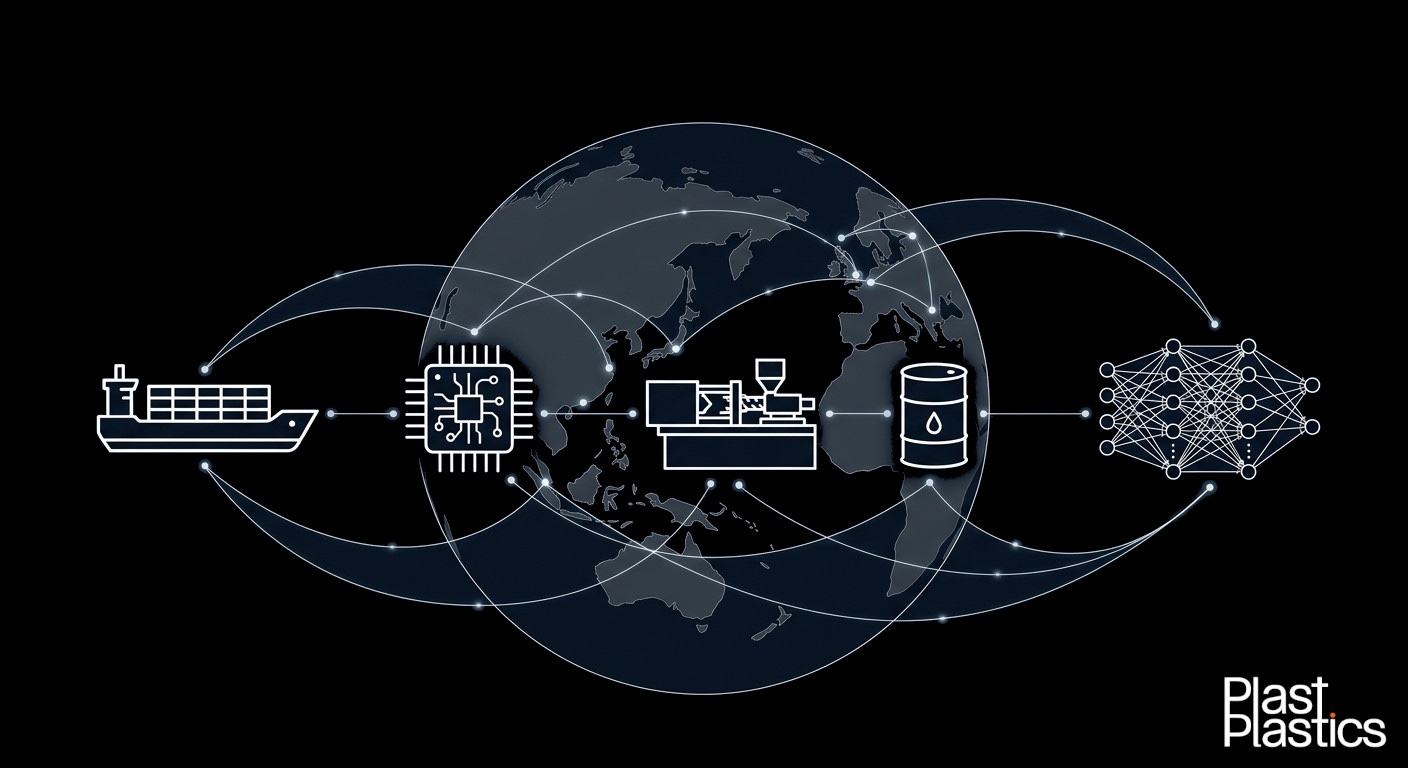
Manufacturing in an Era of Permanent Volatility: Why Competitive Advantage Is Shifting Beyond Cost
For more than three decades, manufacturing strategy has largely been defined by one objective: improving efficiency. Lean production, global sourcing, just-in-time inventory and cost optimisation became the dominant operating model as businesses capitalised on an increasingly stable geopolitical and economic environment.
That model is now under pressure.
The Financial Times Professional report The World in 2026 argues that businesses are entering a fundamentally different operating environment, characterised by geopolitical fragmentation, persistent energy volatility, technological disruption and structural uncertainty rather than isolated crises. Rather than expecting a return to stability, organisations should prepare for an era where volatility itself becomes a permanent feature of global business.
For manufacturers, this represents more than a cyclical downturn or another supply chain disruption. It signals a shift in the basis of competitive advantage. While cost and productivity remain essential, future competitiveness will increasingly depend on resilience, adaptability and trust.
For precision plastic injection moulders serving industries such as aerospace, medical technology, semiconductors and industrial engineering, these shifts are likely to be felt earlier and more acutely than many other manufacturing sectors.
From Global Optimisation to Strategic Resilience
The manufacturing industry has experienced no shortage of disruption over the past five years.
A global pandemic exposed the fragility of highly optimised supply chains. Geopolitical tensions reshaped trade relationships. Inflation and rising interest rates increased operating costs. Artificial intelligence has begun transforming knowledge-intensive work. More recently, instability in the Middle East has demonstrated how quickly energy markets can influence manufacturing costs
Individually, each event could be considered temporary.
Collectively, they suggest something different.
Manufacturers are no longer operating in a world where disruption is the exception. They are operating in an environment where disruption must be assumed.
This distinction matters because it changes strategic priorities.
The objective is no longer to build the most efficient operation under ideal conditions. It is to build an organisation capable of maintaining performance under changing conditions.
Three Structural Shifts Reshaping Manufacturing
1. Supply Chains Are Becoming Strategic Assets
Historically, procurement functions focused on securing the lowest total landed cost.
Increasingly, procurement leaders are balancing cost with resilience.
The geopolitical fragmentation described in The World in 2026 reflects a broader trend towards regionalisation, supplier diversification and greater scrutiny of strategic dependencies. apac-
For manufacturers, supplier selection now extends beyond pricing and capacity.
- Questions increasingly include:
- Can suppliers maintain production during geopolitical disruption?
- Are alternative material sources available?
- How quickly can production recover following disruption?
- Is intellectual property adequately protected?
- Can quality remain consistent despite changing market conditions?
As a result, supply chains are evolving from operational functions into strategic assets capable of creating competitive advantage.
2. Energy Has Returned as a Strategic Manufacturing Variable
The relationship between oil prices and plastics manufacturing is well understood.
However, recent geopolitical developments illustrate that energy costs should no longer be viewed simply as an input to resin pricing.
The Financial Times notes that approximately one-fifth of global oil and liquefied natural gas normally passes through the Strait of Hormuz, making geopolitical events in the region significant drivers of manufacturing economics worldwide.
For plastic injection moulders, rising energy costs influence multiple aspects of the business simultaneously.
Resin prices increase.
Electricity costs rise.
Transportation becomes more expensive.
Freight rates become more volatile.
Working capital requirements expand as inventory values increase.
Customer demand may soften as downstream industries respond to higher operating costs.
Consequently, energy volatility affects not only profitability but also pricing strategy, inventory management and capital investment decisions.
Manufacturers that improve energy efficiency, strengthen supplier relationships and increase operational visibility will likely outperform those relying solely on reactive cost management.
3. Artificial Intelligence Is Changing Manufacturing Beyond Automation
Artificial intelligence is frequently discussed in terms of labour displacement.
The Financial Times presents a more nuanced perspective, suggesting that AI is likely to reshape work by augmenting human capability, creating complementary roles and increasing productivity rather than simply eliminating jobs.
The implications for manufacturing are significant.
The greatest opportunity may not lie in replacing operators with autonomous factories.
Instead, AI has the potential to improve thousands of operational decisions made every day.
Examples include:
- Predicting process drift before dimensional defects occur.
- Optimising machine parameters across multiple production runs.
- Identifying maintenance requirements before equipment failure.
- Accelerating root cause analysis using historical production data.
- Improving production scheduling through dynamic capacity planning.
- Capturing engineering knowledge that would otherwise remain dependent on individual experience.
The competitive advantage therefore shifts from automation alone towards decision intelligence.
Manufacturers capable of combining experienced engineering teams with AI-supported decision making are likely to improve quality, productivity and responsiveness simultaneously.
The Emerging Manufacturing Operating Model
Taken together, these structural shifts suggest that manufacturing competitiveness is evolving beyond traditional measures of efficiency.
Five capabilities increasingly distinguish resilient manufacturers.
Commercial resilience
The ability to respond quickly to changing customer demand, pricing pressures and evolving market conditions.
Supply resilience
Diversified suppliers, strategic sourcing and visibility across critical material flows.
Operational resilience
Stable manufacturing processes supported by digital monitoring, predictive maintenance and disciplined quality systems.
Technological resilience
The ability to integrate automation, artificial intelligence and data analytics into day-to-day operations.
Organisational resilience
A workforce capable of continuous learning, rapid adaptation and cross-functional collaboration.
These capabilities reinforce one another.
An organisation may possess world-class machinery, but without resilient suppliers or adaptable people, operational performance remains vulnerable.
Implications for Precision Plastic Injection Moulding
Precision plastic manufacturers occupy a unique position within this evolving landscape.
Many operate in sectors where quality requirements are stringent, engineering polymers are increasingly specialised and customer qualification processes continue to become more demanding.
Industries such as aerospace, medical technology, semiconductor manufacturing and defence increasingly expect suppliers to demonstrate not only manufacturing capability, but also process maturity, traceability, cybersecurity, sustainability and business continuity.
This changes the nature of competition.
Winning future programmes will depend less on offering the lowest piece price and more on demonstrating confidence across the entire manufacturing system.
Customers are increasingly selecting suppliers capable of reducing operational risk.
Singapore's Strategic Position
These structural changes also strengthen the strategic role of manufacturing ecosystems characterised by stability, transparency and trusted governance.
For many years, Singapore's manufacturing proposition centred on engineering capability, infrastructure and workforce quality.
Today, additional attributes are becoming increasingly valuable.
Strong intellectual property protection.
Regulatory certainty.
Political stability.
Reliable legal institutions.
Advanced logistics.
A highly connected supplier ecosystem.
As global supply chains become more fragmented, these characteristics increasingly reduce operational risk for multinational customers.
For high-value manufacturing, trust is becoming a measurable economic asset rather than simply a desirable reputation.
Looking Ahead
Manufacturing leaders spent much of the past thirty years optimising cost.
The next decade is likely to demand something different.
The organisations that outperform will not necessarily be those with the lowest labour costs or the largest factories.
They will be those capable of maintaining consistent quality, adapting rapidly to changing market conditions and building trusted relationships across increasingly complex supply networks.
For precision manufacturers, resilience is no longer a defensive capability.
It is becoming a driver of growth.
As The World in 2026 suggests, volatility is unlikely to disappear.
Rather than waiting for stability to return, manufacturers should consider redesigning their operating models for a future where uncertainty is expected rather than exceptional.
The next generation of manufacturing competitiveness will be defined not only by what companies produce, but by how confidently they can continue producing it when the world around them changes.