
A medical device component can look right, fit correctly and pass inspection at room temperature, yet still fail in the environment for which it was designed.
We recently encountered exactly that problem.
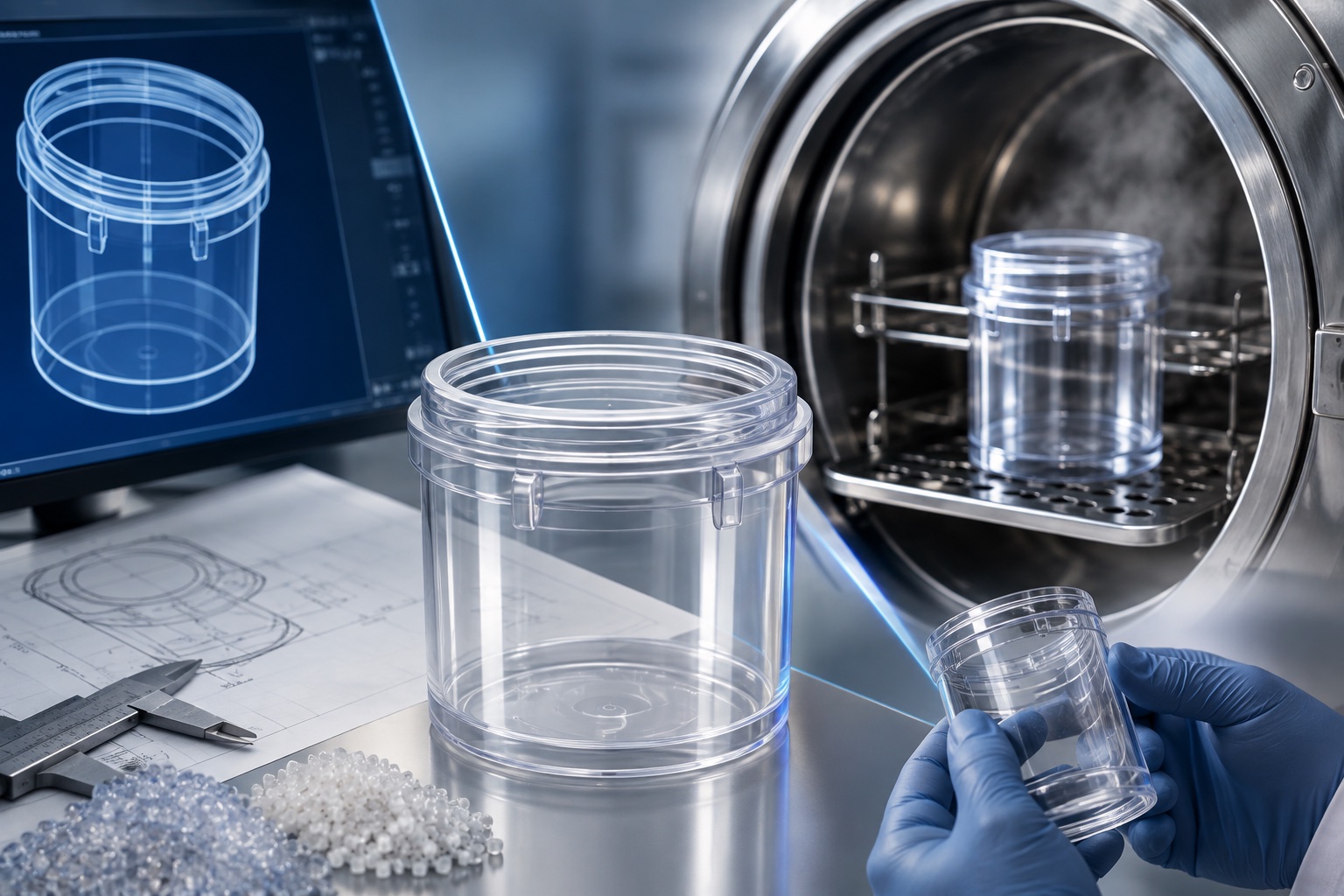
A first batch of a sterilisation-related plastic component produced overseas appeared acceptable when received. But when exposed to an autoclave cycle at around 120°C, two issues became apparent: the component developed a noticeable petrochemical odour, and the component became unstable enough to wobble during sterilisation.
Neither issue was obvious from the drawing.
Neither was apparent during a normal visual inspection.
And neither could be solved simply by asking whether the part had been moulded to dimension.
The real question was more fundamental:
Was the material and manufacturing process suitable for the actual operating environment?
That question sits at the heart of one of the most important challenges facing Singapore’s growing MedTech sector.
Singapore has built a formidable medical technology ecosystem. According to Singapore’s Ministry of Trade and Industry, MedTech manufacturing output grew from S$5.5 billion in 2013 to S$20.3 billion in 2024, alongside capabilities spanning research, product development, advanced manufacturing and global market access.
The next challenge is not only creating more medical products.
It is ensuring that those products can move reliably from prototype to validated, scalable production.
The prototype proves the product. Production must prove the process.
Prototype development and production engineering answer different questions.
A prototype is primarily intended to establish whether a concept works.
Production must establish whether the product can be manufactured repeatedly, within specification, under controlled conditions, and continue to perform under its intended use environment.
That distinction becomes particularly important for medical devices.
A plastic component may behave perfectly at 23°C and differently at 121°C.
A polymer may meet its tensile-strength requirement but soften under sterilisation.
A part may maintain its dimensions immediately after moulding but distort during repeated thermal cycling.
A material may technically withstand the required temperature but generate unacceptable odour, surface changes or dimensional instability under actual processing conditions.
A multi-cavity tool may produce several nominally identical components while introducing subtle cavity-to-cavity variation.
These are not exceptional problems.
They are part of industrialisation.
And in MedTech, discovering them late can have consequences far beyond scrap.
Late material changes can affect tooling, validation, documentation, regulatory work and production timelines.
A real-world lesson in sterilisation
Our sterilisation component provides a useful example.
The original batch exposed two warning signs during elevated-temperature testing: odour and dimensional instability.
The petrochemical smell does not by itself prove that the material was unsafe or unsuitable. Odour can arise from several sources, including polymer degradation, additives, processing conditions or contamination. It should therefore be treated as an observation requiring investigation rather than evidence of a specific chemical problem.
The dimensional behaviour was easier to observe.
At approximately 120°C, the component became unstable enough to wobble.
That immediately shifted the engineering discussion away from one simple question:
Does the material survive the temperature?
towards a more useful one:
Does the finished component retain sufficient mechanical and dimensional stability at the required temperature, under its actual loading and geometry?
We subsequently began evaluating TPX, or polymethylpentene, for the component.
Mitsui Chemicals describes TPX as a high-heat-resistance polymer with a melting point of approximately 220°C to 240°C, while also noting that heat distortion under stress must still be considered carefully.
That distinction matters.
During our own preliminary testing, the material became noticeably less rigid at around 130°C but retained the overall geometry of the component.
That does not yet prove that the final part is validated for medical use.
But it illustrates a critical engineering principle:
Melting point is not the same as usable service performance.
A polymer can remain far below its melting temperature while its stiffness, creep behaviour or dimensional stability changes substantially.
The datasheet is the beginning, not the conclusion
Material selection is often approached through datasheet comparison.
Teams compare:
- tensile strength
- flexural modulus
- glass-transition temperature
- melting point
- chemical resistance
- impact strength
- density
These properties are important.
But medical-device applications require another layer of thinking.
The relevant question is not simply:
Which material has the highest temperature rating?
It is:
How will this specific material grade behave in this specific geometry, after this moulding process, under this sterilisation cycle, while supporting this load, over the expected number of uses?
For a sterilisation-related component, engineers may need to evaluate:
- dimensional change before and after sterilisation
- rigidity at elevated temperature
- creep under load
- recovery after cooling
- repeated autoclave cycles
- chemical and moisture exposure
- surface condition
- odour or visible degradation
- mating and sealing behaviour
- long-term ageing
The material specification alone cannot answer all of these.
The finished component must be tested.
Why room-temperature inspection is not enough
Manufacturing quality systems naturally rely heavily on dimensional inspection.
That is necessary, but not always sufficient.
Consider a plastic component required to operate during steam sterilisation.
A coordinate measurement or optical measurement performed at room temperature may confirm that:
- diameter is correct
- height is correct
- wall thickness is within tolerance
- mating features fit correctly
- the component sits flat
Yet once the component enters an autoclave, the engineering environment changes.
Temperature affects polymer stiffness.
Residual moulding stresses may relax.
Different wall sections may expand and contract differently.
The component may carry load differently.
Moisture and steam may interact with the polymer.
A part that passes dimensional inspection may therefore still experience functional failure.
This leads to an important principle for MedTech manufacturing:
A component should be validated in the environment in which it is expected to perform, not only in the environment in which it is easiest to measure.
Material and process cannot be separated
Switching to a more heat-resistant polymer does not automatically solve the problem.
The performance of an injection-moulded component depends on the interaction between material, geometry, tooling and processing.
Variables may include:
- melt temperature
- mould temperature
- injection speed
- packing pressure
- packing time
- cooling time
- gate position
- wall-thickness distribution
- fibre orientation for reinforced materials
- residual stress
- part ejection conditions
Two components moulded from the same resin can behave differently if the processes used to manufacture them differ significantly.
This is why MedTech manufacturing cannot be reduced to material selection alone.
Material selection establishes the potential performance envelope.
Process development determines whether the moulded component achieves it consistently.
Design decisions become manufacturing decisions
The same principle applies to product geometry.
Suppose a component has one relatively thick base supporting thinner walls.
The thicker region may cool more slowly.
That can create differential shrinkage.
At room temperature, the deformation might be minimal.
At sterilisation temperature, reduced stiffness can amplify the effect.
Similarly, a feature designed with unnecessarily tight tolerances may require a level of process control that becomes difficult to maintain after repeated thermal cycling.
This is where design for manufacturability becomes particularly important.
Product teams should consider manufacturing before the design is frozen.
Questions should include:
- Are wall thicknesses reasonably uniform?
- Which dimensions are genuinely critical to function?
- Where will the part be gated?
- How will it cool?
- Where are residual stresses likely to develop?
- What happens when the component reaches operating temperature?
- Can it be measured after thermal exposure?
- Does the selected material retain adequate stiffness under load?
The cost of answering these questions is relatively low during design.
It becomes considerably higher after production tooling has been completed.
Validation should influence process design, not follow it
This distinction is especially important in medical-device manufacturing.
Singapore’s Health Sciences Authority regulates medical devices under the Health Products Act and the Health Products (Medical Devices) Regulations 2010, including the manufacture and supply of medical devices in Singapore.
That regulatory context reinforces a broader manufacturing principle:
A controlled product requires a controlled process.
For manufacturers, that means thinking early about:
- critical-to-quality characteristics
- tooling qualification
- process windows
- first-article inspection
- calibration
- material traceability
- production records
- controlled engineering changes
- nonconformance management
Validation should not become a documentation exercise performed once tooling and production parameters have already been finalised.
The expected validation pathway should influence how the manufacturing system is designed from the beginning.
Scaling introduces a second engineering challenge
A process can perform well during prototype or low-volume production and still encounter problems when volumes increase.
Consider the seemingly simple decision to move from one cavity to four cavities.
Production capacity may increase substantially.
But so can manufacturing complexity.
Each cavity may experience slightly different:
- filling pressure
- cooling conditions
- shrinkage
- tool temperature
- venting
- wear
What was once one process output becomes four related process outputs.
That introduces questions about cavity balance and capability.
Increasing from four to eight cavities magnifies those considerations further.
For MedTech programmes, this means cavity count should not be treated solely as a unit-cost decision.
The manufacturing team must consider the relationship between:
volume, economics, process capability and validation burden.
The lowest theoretical unit cost does not always produce the lowest total programme risk.
Why this matters for Singapore
Singapore has already established itself as an important MedTech manufacturing centre.
The Ministry of Trade and Industry reported that MedTech manufacturing output reached S$20.3 billion in 2024.
It has also highlighted Singapore’s outsized position in high-value medical manufacturing, noting that approximately one in ten contact lenses globally and one in five cardiac-related implants are manufactured here.
The ecosystem is now evolving further.
A*STAR’s MedTech Catapult was created as a national initiative to accelerate high-value MedTech productisation, strengthen local design and development capabilities, and support manufacturing capability.
That points towards a broader opportunity.
Singapore’s next competitive advantage may not simply come from manufacturing more medical devices.
It may come from becoming better at the difficult transition between:
prototype → engineering → validation → scalable production
That requires collaboration between:
- medical innovators
- product designers
- material suppliers
- toolmakers
- injection moulders
- quality teams
- regulators
- research institutions
Manufacturing becomes part of product development rather than the activity that begins after product development ends.
The real definition of production readiness
Our sterilisation-component experience is still a work in progress.
The replacement material is undergoing further evaluation.
That is precisely why the case is useful.
Engineering rarely progresses in a straight line from drawing to finished product.
There are hypotheses.
There are tests.
There are unexpected results.
There are material changes.
There are process adjustments.
And there are new questions generated by every experiment.
Production readiness is therefore not achieved when the first acceptable component emerges from a mould.
It is achieved when there is sufficient evidence that:
- the design works
- the material performs as intended
- the process is stable
- the product can be measured reliably
- performance survives realistic use conditions
- manufacturing can be repeated at the required scale
For MedTech products, those distinctions matter.
Singapore has already demonstrated that it can build an internationally competitive biomedical and MedTech manufacturing ecosystem.
Its next opportunity is to make the transition from innovation to industrialisation faster, more predictable and more integrated.
Because the prototype proves that the idea can work.
Production must prove that it will keep working.
Sources and further reading
- Singapore Ministry of Trade and Industry, Speech at the Singapore Medical Device Venture Showcase, July 2026. Reports that Singapore’s MedTech manufacturing output grew from S$5.5 billion in 2013 to S$20.3 billion in 2024 and highlights capabilities across research, product development, advanced manufacturing and market access.
- Mitsui Chemicals, TPX™ product properties. Mitsui reports a TPX melting-point range of approximately 220°C to 240°C and high Vicat softening temperature, while noting that heat distortion under high-stress conditions requires careful consideration.
- Singapore Health Sciences Authority, Medical Devices Regulatory Overview. HSA regulates medical devices under Singapore’s Health Products Act and Health Products (Medical Devices) Regulations 2010 and regulates the manufacture and supply of medical devices.
- Singapore Ministry of Trade and Industry, Launch of MedTech Catapult, February 2025. MTI reports that approximately one in ten contact lenses and one in five cardiac-related implants used globally are manufactured in Singapore.
- A*STAR, MedTech Catapult. A national initiative focused on accelerated and high-value MedTech productisation and strengthening Singapore’s design, development and manufacturing capabilities.
- Singapore Ministry of Trade and Industry, Biomedical Sciences sector update, May 2026. MTI reported S$4.4 billion in biomedical-sciences investment commitments secured in 2025, expected to create 1,775 jobs over five years, reinforcing continued investment in the biomedical ecosystem.