
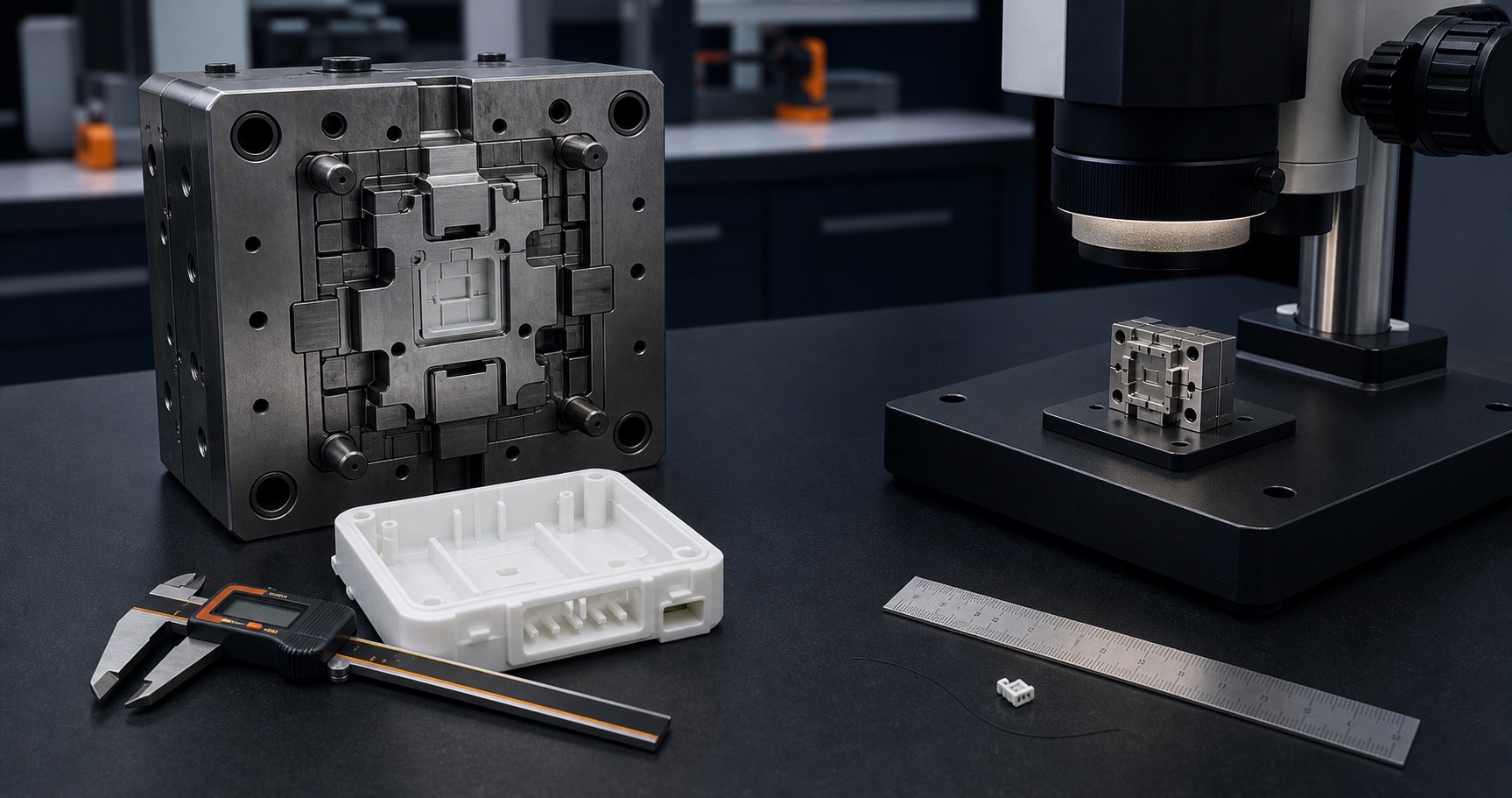
Very small plastic components create manufacturing challenges that are easy to underestimate. The part may weigh only a fraction of a gram, but the mould still has to fill consistently, the material must be metered accurately, the component must be ejected without damage, and its critical features must be measured.
This leads to an important question: does the project require dedicated micro moulding, or can it be produced reliably using conventional injection moulding?
The answer is not determined by one dimension. It depends on the interaction between part size, shot size, feature geometry, material behaviour, tooling, handling, inspection and production volume.
What is conventional injection moulding?
Conventional injection moulding uses a reciprocating screw to plasticise polymer pellets, meter a shot and inject the molten material into a closed mould. It is a mature, scalable process capable of producing a very wide range of components, from relatively small precision parts to much larger housings and structural products.
For many applications, conventional moulding provides the right balance of:
- Available machine capacity
- Tooling flexibility
- Material compatibility
- Production rate
- Automation options
- Cost per component
A small component does not automatically require a micro-moulding machine. If the shot can be controlled reliably, the features can be filled and replicated, the part can be ejected and handled, and the critical dimensions can be measured, conventional injection moulding may remain the most practical solution.
Learn more about Plast Plastics’ conventional plastic injection moulding capabilities.
What is micro moulding?
Micro moulding is a specialised form of injection moulding designed for very small shot volumes, miniature components, micro-scale features or unusually demanding precision requirements.
Micro-moulding projects generally fall into three broad groups:
- Components that are extremely small overall
- Larger components containing micro-scale features
- Precision components where critical dimensions or tolerances demand micro-scale control
This broader definition is consistent with technical literature covering miniature parts, conventionally sized parts with micro-scale features, and precision components with micro-scale requirements (Zhang, Liu and Zhang, 2022).
This distinction matters. A component does not need to be microscopic in every dimension to present a micro-moulding challenge. A larger part with a very small channel, thin section, pin, gear tooth, optical feature or connector detail may require the same level of specialised tooling, process control and metrology as a much smaller component.
Explore Plast Plastics’ micro moulding capabilities.
Part size alone is not enough
The most common mistake is to choose the process using only the component’s overall length, width or weight. These measurements are useful, but they do not describe the most difficult feature.
Instead, review:
- The smallest wall thickness
- The narrowest flow path
- The smallest hole, rib, pin or channel
- Aspect ratios of tall or deep features
- Gate size and acceptable gate vestige
- Distance the polymer must flow through thin sections
- Flatness, concentricity and positional requirements
- Risk of distortion during ejection and handling
A relatively small but uncomplicated part may mould well conventionally. A larger component with a difficult micro-feature may require a specialised process.
1. Shot size and metering control
Every injection unit has a practical operating range. If the required shot is extremely small compared with the capacity of a conventional barrel and screw, small variations in screw movement, check-ring behaviour or material condition can become significant relative to the amount of polymer entering the cavity.
The machine may also need a larger runner and sprue simply to reach a controllable shot size. This can mean processing much more material than the finished component actually contains.
Dedicated micro-moulding systems are designed to meter and inject very small quantities of polymer more precisely. Some separate plasticising from injection, using a screw to prepare the melt and a smaller plunger or piston to deliver the shot. This can improve control over very small melt volumes. One commercial example is WITTMANN’s two-step MicroPower injection unit, which uses a plasticising screw and separate injection plunger (WITTMANN MicroPower technical brochure).
The relevant question is therefore not merely, “How much does the part weigh?” It is, “Can the complete shot be metered and injected repeatedly within the stable operating range of the proposed equipment?”
2. Material residence time and thermal history
When a tiny amount of polymer is consumed during each cycle, material can remain in an oversized barrel for longer than intended. Excessive residence time may expose the resin to prolonged heat and increase the risk of degradation, colour change or inconsistent properties.
This is particularly important for:
- Heat-sensitive polymers
- Expensive engineering resins
- Materials with narrow processing windows
- Applications where contamination or material history is tightly controlled
A smaller, appropriately sized plasticising system can reduce the mismatch between barrel capacity and material consumption. Material drying, storage, handling and changeover procedures remain equally important.
The supplier should assess the exact resin grade, not only the polymer family. Flow behaviour, reinforcement, additives and thermal sensitivity can all affect the process choice.
3. Filling micro-features
Polymer begins cooling as soon as it contacts the mould. In a micro-scale channel or very thin section, the available flow area can reduce rapidly. The process may therefore require careful control of injection speed, melt temperature, mould temperature and venting to fill the feature before it freezes. Review research highlights the importance of rapid filling, thermal conditions, rheology and tooling when replicating micro-scale polymer features (Zhang, Liu and Zhang, 2022).
High injection speed alone is not a complete solution. Excessive pressure or poor tool alignment can contribute to flash, while aggressive processing can affect material behaviour and part properties. The objective is a stable process window that fills and packs the component without creating new defects.
The supplier should review:
- Flow length relative to thickness
- Gate position and gate dimensions
- Venting at the end of fill
- Mould-temperature strategy
- Injection speed and pressure capability
- Potential weld lines or trapped gas
- Replication of textured or functional micro-features
Simulation can support the discussion, but micro-scale flow and thermal behaviour may not always be represented with the same confidence as conventional geometries. Sampling and measurement remain essential.
4. Tooling precision
The mould sets the upper limit for what the process can reproduce. If a critical feature is not manufactured accurately in the tool, the moulding machine cannot correct it.
Micro-moulding tooling may require:
- High-precision inserts
- Very small gates and vents
- Accurate cavity alignment
- Fine surface finishes
- Specialised machining or electrical-discharge processes
- Careful control of parting lines and shut-offs
- Replaceable inserts for vulnerable features
Tooling decisions should also consider maintenance. Small vents, pins, edges and features can be more sensitive to wear, damage or contamination. The maintenance plan and inspection method should be considered during tool design, not after production begins.
See Plast Plastics’ tooling and mould maintenance capabilities.
5. Gates, runners and material efficiency
In conventional moulding, the sprue and runner can sometimes weigh far more than a micro component. That may be acceptable for an inexpensive resin if the runner can be managed appropriately. It may be commercially unattractive when the material is costly, sensitive or subject to strict controls.
The tooling strategy should evaluate:
- Runner-to-part weight ratio
- Cold-runner versus alternative feed approaches
- Gate removal and acceptable vestige
- Separation of components from runners
- Whether regrind is allowed
- Material loss during start-up and process stabilisation
Material efficiency should be assessed together with tooling cost and process stability. Eliminating runner material is not valuable if it creates a more expensive or less reliable production system.
6. Ejection and part handling
Producing the component is only part of the challenge. A micro part can be difficult to eject, separate, orient, count, inspect and package.
Very small components may:
- Adhere to the tool or handling surfaces
- Be affected by static charge
- Deform under conventional ejector forces
- Become difficult to distinguish from runner fragments
- Require controlled collection or automated handling
- Be lost or damaged during transfer
The manufacturing concept should therefore cover the entire path from cavity to final packaging. Ask how the supplier will confirm that every shot has been ejected, prevent mixing or loss, and protect delicate features.
For some projects, handling and inspection have a greater effect on total cost than the moulding cycle itself.
7. Measurement and quality control
As components and features become smaller, conventional contact measurement may become impractical or may influence the part being measured. Optical systems, specialised fixtures and carefully developed measurement methods may be required. CIRP research on industrial micro-moulded components demonstrates why measurement capability and uncertainty must be considered alongside the tolerance itself (Tosello, Hansen and Gasparin, 2009).
Before finalising the drawing, discuss:
- Which dimensions are critical to function
- Whether the feature can be accessed by the proposed equipment
- Measurement uncertainty relative to the tolerance
- Part fixturing and orientation
- Sampling frequency
- Surface, burr and flash assessment
- Traceability and retention of inspection data
A tolerance has little practical value if the agreed measurement system cannot verify it consistently.
Quality planning should also account for cavity-to-cavity variation in multi-cavity tools. The inspection strategy may need to retain cavity identity rather than treating all components as one undifferentiated batch.
Explore Plast Plastics’ quality and precision measurement capabilities.
8. Production volume and economics
Micro moulding can provide excellent material efficiency and process control, but specialised tooling, equipment, inspection and handling may increase initial investment.
Conventional moulding may be more economical when:
- The component is small but not especially difficult
- The total shot remains within a stable machine range
- Standard tooling and inspection methods are adequate
- Production volumes do not justify specialised automation
- Runner material and handling costs remain acceptable
Micro moulding becomes more attractive when:
- Shot size is too small for reliable conventional metering
- The runner would consume disproportionate material
- Critical micro-features cannot be replicated consistently
- Material residence time presents a risk
- Dedicated handling and inspection are required
- The cost of variation or failure is high
The comparison should be based on total manufacturing cost, not machine rate alone. Include tooling, material yield, cycle time, inspection, handling, scrap, packaging and quality risk.
Conventional or micro moulding: a practical comparison
Choose conventional injection moulding when the proposed machine can meter the shot reliably, fill the geometry, control the material and produce a part that can be handled and measured using practical methods.
Consider dedicated micro moulding when the combination of shot size, micro-features, material, precision or handling moves beyond the stable capability of conventional equipment.
In a controlled study using the same micro thermoplastic-elastomer component, dedicated micro-injection moulding delivered better precision, accuracy and cavity balance than the conventional process used for comparison. This does not mean micro moulding is automatically superior for every small part, but it demonstrates that equipment selection can materially affect micro-production capability (Baruffi et al., 2018).
There is an important middle ground. Some projects can be produced on smaller conventional machines or with adapted tooling. Others appear straightforward until testing reveals unstable shot control, excessive runner waste, incomplete replication or measurement difficulties.
The correct decision should follow an engineering review, not a label applied solely from the part’s dimensions.
Information to provide for a feasibility review
To help a moulding partner assess the process, provide:
- 2D drawings and 3D CAD files
- Overall part dimensions and estimated weight
- Critical micro-features and tolerances
- Material grade and approved alternatives
- Functional and cosmetic requirements
- Expected annual volume and batch size
- Mating parts or assembly information
- Inspection and traceability requirements
- Packaging and handling expectations
- Prototype or existing production samples, if available
Identify which requirements are fixed and which remain open to engineering discussion. This allows the supplier to propose the most appropriate tooling, equipment and quality approach.
Choosing the process that fits the part
Micro moulding is not simply conventional injection moulding scaled down. At very small shot volumes and feature sizes, metering, material behaviour, tooling, ejection and measurement become more sensitive.
At the same time, not every small plastic component needs a dedicated micro-moulding process. Selecting a more specialised process than the application requires can add unnecessary cost and complexity.
Plast Plastics offers both micro moulding and conventional plastic injection moulding in Singapore, supported by tooling, finishing, assembly and precision measurement capabilities. This allows the manufacturing approach to be selected around the component’s actual requirements rather than forcing every project into one process.
Technical sources and further reading
- Baruffi, F., Charalambis, A., Calaon, M., Elsborg, R. and Tosello, G. (2018). Comparison of micro and conventional injection moulding based on process precision and accuracy. *Procedia CIRP*, 75, 149–154.
- Zhang, H., Liu, H. and Zhang, N. (2022). A Review of Microinjection Moulding of Polymeric Micro Devices. *Micromachines*, 13(9), 1530.
- Tosello, G., Hansen, H.N. and Gasparin, S. (2009). Applications of dimensional micro metrology to the product and process quality control in manufacturing of precision polymer micro components. *CIRP Annals*, 58(1), 467–472.
- WITTMANN BATTENFELD. MicroPower 15 t technical brochure. Official equipment documentation covering two-step plasticising and injection, process control, automation and micro-part handling.
Send us your drawing, material requirements and expected volumes for an engineering feasibility review.