
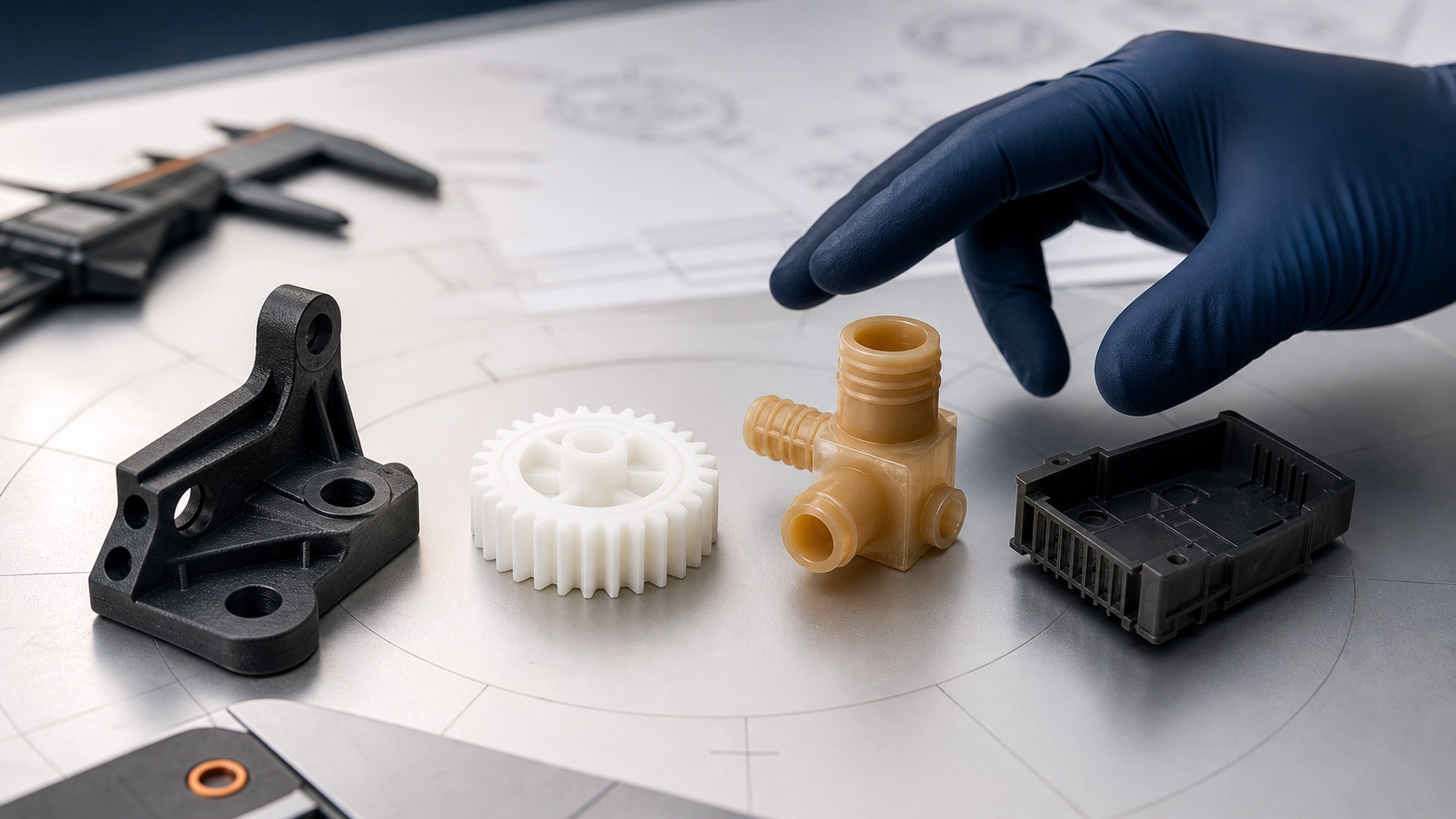
When specifying materials for precision injection moulded components, engineers face a fundamental challenge. With over 85,000 commercially available plastic grades, selecting the right engineering thermoplastic can feel overwhelming. The stakes are high. An inappropriate material choice can lead to premature part failure, costly redesigns, or overspecification that erodes product competitiveness.
This article provides a practical framework for selecting engineering thermoplastics such as polyamides (PA), polyoxymethylene (POM), polyetheretherketone (PEEK) and liquid crystal polymers (LCP). It focuses on the trade-offs that matter most in electronics, medical and industrial applications, helping you make informed decisions without unnecessary complexity.
Why material selection matters in precision moulding
The choice of engineering plastic directly influences component performance, manufacturability and total cost of ownership. In high-performance applications, materials must withstand continuous operating temperatures from 80°C to over 250°C, resist chemical exposure to fuels, oils, solvents or bodily fluids, and maintain dimensional stability under mechanical load.
Material selection errors are common. Engineers often default to familiar materials like PA66 or ABS not because they are optimal, but because they are known. A systematic comparison can surface better alternatives that reduce cost by 30 per cent or improve performance significantly.
For Singapore-based manufacturers serving regional supply chains, the commercial implications extend beyond technical performance. Lead times, resin availability, and material cost volatility all affect production planning and procurement strategy. Understanding the engineering thermoplastics landscape helps procurement professionals negotiate more effectively, and suppliers can advise on viable alternatives when primary materials face supply constraints.
At Plast Plastics, we review geometry, material, load conditions and production requirements before recommending a manufacturing approach. This engineering-led approach ensures material selection aligns with both performance needs and manufacturing feasibility. Learn more about our approach on our Industries page.
A four-step decision framework for engineering plastics
A structured approach to material selection reduces the risk of specification errors. The following framework, adapted from industry guidance, helps narrow options systematically.
Step 1: Define the continuous operating temperature
Operating temperature is the single most important filter. It eliminates approximately 80 per cent of unsuitable options immediately.
- **Below 80°C:** ABS, PC/ABS, PA6, PA66, POM, PMMA, PET, PBT
- **80°C to 120°C:** PA66 glass-filled, PBT glass-filled, PET glass-filled, PPO/PPE, PC
- **120°C to 180°C:** PPS, PPA, PA46, PEI (Ultem), PSU, PES
- **180°C to 260°C:** PEEK, PAI (Torlon), LCP
- **Above 260°C:** PI (Vespel) only
Specifying PEEK for an application that operates at 100°C is a common overspecification error. PPS or glass-filled PA66 would perform adequately at 40 to 60 per cent of the material cost.
Step 2: Assess chemical exposure
Will the component contact fuels, oils, solvents, acids or bases? Chemical resistance requirements eliminate additional candidates:
- PA (nylon) dissolves in acids and absorbs moisture, affecting dimensional stability
- PC stress-cracks in many solvents
- POM degrades in acids and should not contact PVC
For aggressive chemical environments, PPS, PEEK or fluoropolymers offer superior resistance. PEEK is inert to all common solvents and exhibits excellent resistance to a wide range of organic and inorganic liquids, making it suitable for harsh industrial and medical applications.
Step 3: Calculate mechanical load requirements
Determine the required tensile strength with an appropriate safety factor. Material capability ranges are:
- Unfilled grades: 40 to 100 MPa
- Glass-reinforced grades: 130 to 220 MPa
- Carbon-fibre reinforced grades: 200 to 250 MPa
For wear applications requiring low friction and high stiffness, POM (acetal) offers metal-like rigidity with a modulus of 2.7 to 3.1 GPa and a low coefficient of friction around 0.2. This makes it ideal for gears, bearings and sliding components without external lubrication.
Step 4: Evaluate cost and availability
Rank remaining candidates by cost per kilogram and verify whether a lower-tier material can meet requirements. The most common cost mistake is specifying PEEK when PPS would perform identically at 40 per cent of the cost.
For Singapore manufacturers, resin availability and regional supply-chain resilience also affect total cost. Materials with multiple qualified suppliers and established regional distribution reduce procurement risk.
Common engineering thermoplastics and their trade-offs
Polyamides (PA6 and PA66)
Polyamides, commonly known as nylons, are among the most widely used engineering thermoplastics. PA66 generally offers slightly better performance in stiffness and heat resistance, while PA6 is easier to process and has better impact resistance. PA66 is slightly stronger and more dimensionally stable, whereas PA6 is tougher, absorbs more water, and has a wider, more forgiving processing window.
**Typical applications:** Electrical connectors, automotive under-hood components, industrial gears, cable ties, consumer appliance parts
**Advantages:**
- Good mechanical strength and toughness
- Reasonable cost among engineering plastics
- Wear resistance suitable for many tribological applications
- Available in glass-filled grades for enhanced stiffness
**Trade-offs:**
- Moisture absorption affects dimensional stability (PA6 more than PA66)
- Limited chemical resistance to acids and strong oxidising agents
- Continuous service temperature typically limited to 80°C to 120°C depending on grade
Polyoxymethylene (POM, acetal)
POM, also known as acetal, is the preferred engineering resin when designers need metal-like rigidity, tight tolerances and outstanding low-friction performance straight from the mould. It offers high modulus (2.7 to 3.1 GPa), low coefficient of friction (0.2), and excellent creep and fatigue resistance.
**Typical applications:** Fuel-system valves, window-lift gears, conveyor sprockets, pump impellers, medical device components such as insulin-pen plungers and inhaler dose counters
**Advantages:**
- Exceptional dimensional stability with low moisture absorption (under 0.8 per cent)
- Self-lubricating properties reduce or eliminate need for external lubrication
- Good chemical resistance to fuels, solvents and detergents
- Can hold tight tolerances such as ±0.05 mm
**Trade-offs:**
- Not suitable for acid environments (degrades in dilute mineral acids)
- Cannot contact PVC due to chemical incompatibility
- Processing requires careful temperature control (190°C to 220°C for copolymer) to avoid formaldehyde out-gassing
- Homopolymer grades offer better mechanical properties but are more difficult to process than copolymers
Polyetheretherketone (PEEK)
PEEK is a semi-crystalline, high-temperature-resistant engineering thermoplastic with exceptional chemical resistance, fatigue endurance and thermal stability. It has a continuous service temperature estimated at 250°C (480°F) with excellent mechanical properties retained to temperatures over 300°C (570°F).
**Typical applications:** Aerospace and automotive components, medical implants, spinal fusion devices, pump and valve seats, insulators and connectors, high-performance fluidic components
**Advantages:**
- Outstanding thermal stability with continuous service up to 250°C
- Superior chemical resistance to organic and inorganic liquids
- Excellent mechanical and electrical properties retained at high temperatures
- Biocompatible and suitable for medical implants
- Inherently flame retardant (UL-94 V-0 rating) without additives
**Trade-offs:**
- High material cost restricts use to only the most demanding applications
- Processing requires high melt temperatures (around 343°C melting point)
- Often overspecified when lower-cost alternatives like PPS or PEI would suffice
Liquid crystal polymers (LCP)
LCPs are increasingly preferred for fine-pitch connectors and miniaturised electronics components. They provide excellent flow to fill complex geometries in short cycle times, exceptional thermal and chemical resistance, and achieve UL 94 V-0 flame retardance without flame retardant additives.
**Typical applications:** Surface-mount technology (SMT) connectors, small-outline dual inline memory modules (S/O DIMMs), flexible printed circuit (FPC) connectors for smartphones and tablets, fine-pitch connectors with 0.2 to 0.3 mm pitch spacing
**Advantages:**
- Excellent flow characteristics for thin-wall, complex geometries
- High thermal resistance suitable for surface-mount processing
- Low warpage in very thin wall sections
- Inherently flame retardant without additives
- Good electrical properties for high-frequency applications
**Trade-offs:**
- Higher cost than conventional engineering plastics
- Limited to specialised applications where properties justify cost
- Bonding and assembly can require specialised techniques
Practical checklist for material specification
Before finalising a material specification, confirm the following:
- Continuous operating temperature range and peak excursions
- Chemical exposure (fuels, oils, solvents, acids, bases, bodily fluids)
- Mechanical load requirements including tensile, compressive and impact loads
- Wear or friction requirements at sliding interfaces
- Dimensional tolerance requirements and moisture sensitivity
- Regulatory requirements (biocompatibility, flammability ratings, electrical certifications)
- Cost targets and acceptable trade-offs between performance and price
- Resin availability and supply-chain resilience for your production volumes
When to consult your moulding partner
Material selection is not purely a desk exercise. Injection moulding parameters, mould design, and part geometry interact with material properties in ways that affect achievable tolerances, cycle times and defect rates.
Early engagement with your moulding partner can:
- Identify processing challenges specific to selected materials (for example, POM requires careful temperature control to avoid degradation)
- Suggest alternative materials that meet performance requirements at lower cost
- Advise on mould design considerations such as gate sizing, venting and cooling for specific resins
- Provide samples for testing and validation before committing to production tooling
For precision components in electronics, medical or industrial applications, the commercial value of getting material selection right on the first attempt far exceeds the cost of early consultation.
At Plast Plastics, we specialise in plastic injection moulding from 15T to 380T, micro moulding, over moulding and insert moulding, and comprehensive quality control and assurance. Our team reviews your requirements before recommending a manufacturing approach that balances performance, cost and manufacturability.
Conclusion
Selecting engineering thermoplastics for demanding applications requires balancing thermal performance, chemical resistance, mechanical properties and cost. A systematic decision framework based on operating temperature, chemical exposure, mechanical load and cost helps narrow options efficiently and avoid common overspecification errors.
PA66, POM, PEEK and LCP each serve distinct performance niches. PA66 offers a practical balance of strength, toughness and cost for many applications up to 120°C. POM excels in wear applications requiring low friction and tight tolerances. PEEK justifies its cost in high-temperature, chemically aggressive environments. LCP enables miniaturised electronics components with exceptional flow and thermal resistance.
If you are evaluating a precision plastic component, Plast Plastics can review your requirements, drawings and manufacturing considerations. Contact our Singapore engineering and manufacturing team to discuss the project.
Sources and further reading
- ProppRose. **Engineering Plastic Selection Guide: How to Choose the Right Material for Your Application.** Insights, 4 June 2026. https://propprose.com/insights/plastic-material-selection-guide-engineers/ — Provides a four-step decision framework for selecting engineering plastics based on temperature, chemical exposure, mechanical load and cost.
- CNC Fab Works. **Engineering Plastic Selection Guide: 14 Plastics, When to Use Each.** PrecisionFab, 17 May 2026. https://cncfabworks.com/engineering-plastic-selection-guide/ — Comparison of 14 common plastics across strength, heat, chemical resistance and cost with real selection scenarios.
- Sumitomo Chemical Advanced Technologies. **Liquid Crystal Polymers Increasingly Preferred for Fine-Pitch Connectors.** 10 May 2019. https://sumichem-at.com/liquid-crystal-polymers-increasingly-preferred-for-fine-pitch-connectors/ — Technical overview of LCP applications in fine-pitch connectors and SMT components.
- Piedmont CMG. **PEEK Polyether Ether Ketone: Material Selection Guide.** https://www.piedmontcmg.com/material-selection-guide/peek-polyetheretherketone/ — Properties, applications and performance data for PEEK including temperature, chemical resistance and flammability ratings.
- Taiwan Mold Maker. **Refine Injection-Molding Acetal (POM) for High-Stiffness, Low-Wear Parts.** 31 December 2024. https://www.taiwanmoldmaker.com/news/injection-molding-acetal — Processing guidelines, design considerations and applications for POM (acetal) in precision moulding.