
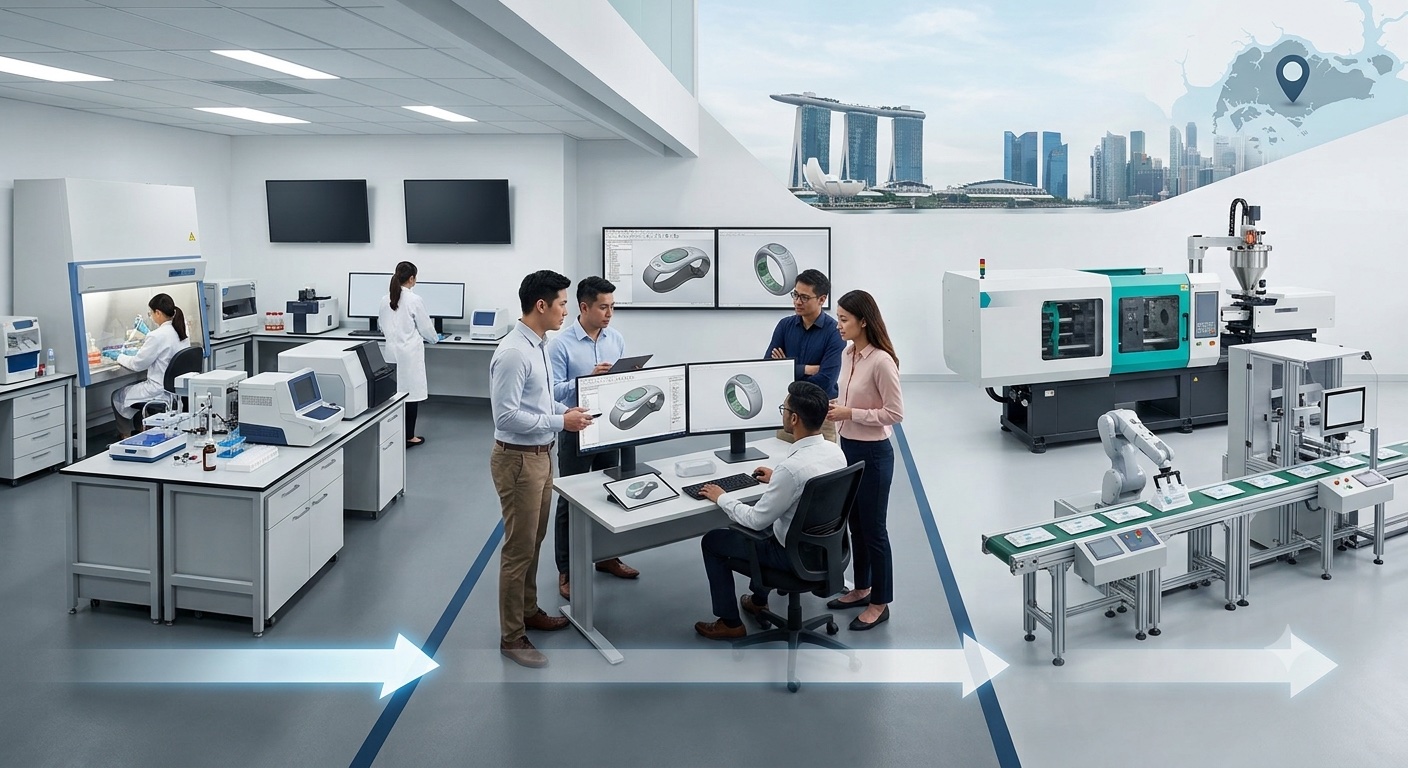
Singapore has spent more than two decades building one of Asia’s most established biomedical ecosystems. It now hosts more than 60 biopharmaceutical manufacturing plants, 30 biomedical research and development centres, and the regional headquarters of over 80 leading biomedical companies. Biomedical manufacturing generated S$38.1 billion in output in 2023.[1]
Medical technology has become a significant industry within this ecosystem. Singapore’s MedTech manufacturing output grew from S$5.2 billion in 2013 to S$19.4 billion in 2023. More than 35 manufacturing plants operated by global MedTech companies are supported by over 2,700 precision-engineering firms and electronics manufacturing service providers.[2]
The country’s next challenge is not simply to attract more research, investment or manufacturing plants. It is to connect these capabilities more effectively.
Clinical discoveries and new medical technologies do not reach patients through research alone. They must be converted into products that can be manufactured consistently, validated rigorously and supplied at commercial scale.
For MedTech companies, this transition requires a coordinated commercialisation system encompassing product design, material selection, tooling, process validation, precision measurement, traceability and supply-chain readiness.
Singapore already possesses many of these capabilities. Its next opportunity is to integrate them into a more complete commercialisation engine.
Singapore’s biomedical hub was built deliberately
Singapore’s position as a biomedical hub did not emerge organically.
More than 20 years ago, the country identified biomedical sciences as a strategic economic sector. It invested in scientific infrastructure, translational research, regulatory capabilities, manufacturing facilities and specialist talent.
This created an ecosystem spanning:
- Biomedical and translational research
- Clinical trials
- Biopharmaceutical production
- Medical-device development
- Precision engineering
- Regulatory oversight
- Regional commercial operations
The strategy has produced substantial results.
Eight of the world’s ten largest biopharmaceutical companies operate manufacturing facilities in Singapore, while biopharmaceutical manufacturing output exceeded S$18 billion in 2023.[3]
Singapore has also developed capabilities extending beyond conventional pharmaceutical production. Its facilities manufacture products ranging from active pharmaceutical ingredients and vaccines to biologics, therapeutics and cell-based products.
In MedTech, the country has moved beyond being a regional distribution base. It has become a location for product development, advanced manufacturing and global supply-chain operations.
The growth of MedTech output from S$5.2 billion to S$19.4 billion in a decade demonstrates the scale of that shift.[2]
The ecosystem is moving closer to patients
The strategic agreements announced at the Singapore Clinical Research Institute Clinical Trials Symposium 2026 represent another stage in the development of Singapore’s biomedical ecosystem.
The partnerships bring together government agencies, healthcare clusters, research organisations, regulators and multinational pharmaceutical companies. Their objectives include strengthening international collaboration, accelerating early-phase trials and improving the development pathway for emerging therapeutic modalities.
These efforts are particularly important as clinical research becomes more complex.
New modalities such as cell and gene therapies, antibody-drug conjugates, radioconjugates and bispecific antibodies require closer coordination across research, clinical, regulatory and industrial stakeholders.
Singapore’s relatively concentrated ecosystem creates an advantage. Researchers, healthcare institutions, regulators, multinational companies and manufacturers can operate within a closely connected national environment.
However, successful clinical research is only one part of the journey.
Once an innovation demonstrates clinical or technical value, it must still be translated into something that can be manufactured repeatedly and delivered reliably.
This is where many commercialisation programmes encounter a second set of challenges.
The commercialisation gap is often a manufacturing gap
A product that works in a laboratory or prototype environment is not automatically ready for commercial manufacturing.
Prototype components may be machined, printed or assembled manually in small quantities. These methods allow product teams to test functionality quickly, but they do not necessarily demonstrate that the product can be manufactured economically or consistently at higher volumes.
The transition to production introduces questions that may not have been addressed during early development:
- Can the component be moulded without warpage, sink marks or incomplete filling?
- Can its tolerances be maintained across several mould cavities?
- Will the selected material withstand sterilisation, chemicals, heat or repeated use?
- Can the component be ejected without damage?
- Can critical characteristics be measured efficiently?
- Can the tool support the expected production volume?
- Can the process be validated and reproduced across multiple production runs?
- Can materials, process parameters and inspection results be traced by batch?
These are not minor production concerns.
They can influence regulatory submissions, tooling investment, product cost, launch timing and supply continuity.
A product may pass its initial functional tests yet require significant redesign when its manufacturing partner reviews the geometry. A polymer may meet mechanical requirements but become unsuitable after exposure to sterilisation conditions. A tightly toleranced feature may be achievable in one cavity but unstable across a multi-cavity tool.
When these issues are discovered after product design has been finalised, changes become slower and more expensive.
The manufacturing gap therefore becomes a commercialisation gap.
Singapore already has the foundations to close it
Singapore does not need to create a MedTech manufacturing ecosystem from the beginning.
Its existing base includes more than 35 global MedTech manufacturing plants and over 2,700 precision-engineering and electronics manufacturing service providers.[2]
These capabilities can support activities ranging from prototyping and tooling to component production, electronics integration, equipment assembly and supply-chain management.
The country also has a regulatory environment designed to protect patient safety while supporting medical innovation. Singapore’s Health Sciences Authority regulates the import, manufacture, export and supply of medical devices. Companies manufacturing medical devices locally generally require the relevant dealer’s licence and must comply with applicable regulatory requirements.[4]
Medical-device clinical trials must comply with the Human Biomedical Research Act. The manufacture, import and supply of medical devices used as clinical research materials are also subject to specific regulatory controls.[5]
This combination of research, regulatory and manufacturing capability gives Singapore the foundations of a complete commercialisation ecosystem.
The opportunity now is to connect the individual elements earlier and more systematically.
Manufacturing should begin before production
In traditional product-development models, manufacturing suppliers are often engaged only after a design has been substantially completed.
For complex MedTech products, that approach can introduce avoidable risk.
Manufacturing input should begin while the design remains flexible.
Design for manufacturability
An early manufacturing review can identify features that may cause mould-filling, cooling or ejection problems.
These may include:
- Non-uniform wall thickness
- Insufficient draft
- Deep ribs
- Undercuts
- Sharp internal corners
- Difficult gate locations
- Features vulnerable to distortion
- Tolerances that exceed process capability
Resolving these issues before tooling begins is usually faster and less expensive than correcting them after steel has been cut.
Material selection
Medical components may be exposed to heat, chemicals, pressure, sterilisation, mechanical loads or repeated handling.
Material selection must therefore consider more than tensile strength or purchase price.
The selected polymer must also be compatible with:
- The intended sterilisation method
- The operating environment
- Regulatory and biocompatibility requirements
- Dimensional stability needs
- Injection-moulding conditions
- Long-term product performance
Material availability and lot consistency should also be considered where the product will enter sustained commercial production.
Tooling strategy
Tooling should reflect the stage of product development and the expected production volume.
A prototype or bridge tool may be appropriate for design verification or early clinical use. A hardened multi-cavity tool may be required for larger commercial volumes.
The transition between these stages should be planned deliberately.
Product teams should consider:
- Tool life
- Number of cavities
- Gate and runner design
- Cooling strategy
- Interchangeable inserts
- Maintenance requirements
- Validation expectations
- Future design changes
- Production-capacity requirements
The lowest-cost mould is not always the lowest-risk solution.
Measurement planning
Critical dimensions should be identified before tooling is completed.
Product teams and manufacturers need to agree on what will be measured, how it will be measured and which characteristics affect product function or patient safety.
This may require:
- Optical measurement
- Coordinate measurement
- Functional gauges
- Vision systems
- Material testing
- Surface inspection
- Process-capability analysis
A tolerance is useful only when the organisation can manufacture and verify it consistently.
Validation and traceability
In medical manufacturing, producing several conforming samples is not sufficient.
The production system must demonstrate that it can repeatedly create acceptable output under controlled conditions.
Depending on the product and customer requirements, this may involve:
- Equipment qualification
- Tooling qualification
- Process-window development
- First-article inspection
- Installation, operational and performance qualification
- Material-lot control
- Calibration records
- Batch traceability
- Nonconformance management
- Controlled engineering changes
The central question is no longer merely whether a good part was produced.
It is whether there is objective evidence that the process can continue producing good parts reliably.
The role of precision plastics manufacturing
Precision plastic components are used across medical devices, diagnostics, laboratory equipment and healthcare systems.
Applications may include:
- Diagnostic cartridges and housings
- Fluid-management components
- Surgical and laboratory instruments
- Drug-delivery devices
- Equipment enclosures
- Wearable products
- Sensor housings
- Single-use consumables
- Sterilisation and autoclave equipment
- Components incorporating metal inserts or overmoulded materials
These parts may appear simple, but their performance can depend on small variations in dimensions, material behaviour, surface condition or assembly fit.
The contribution of a precision injection moulder therefore extends beyond producing parts to a drawing.
A capable manufacturing partner should help customers answer several questions:
- Is the design suitable for repeatable moulding?
- Is the selected polymer appropriate for the application and process?
- Which dimensions are functionally critical?
- How should the component be gated, cooled and ejected?
- What production volume should the tool support?
- How will the part be inspected?
- How will materials and production records be traced?
- How can capacity increase without compromising process control?
This engineering contribution is especially important during the transition from pilot production to commercial scale.
From biomedical hub to commercialisation engine
Singapore has already established itself as an important centre for biomedical research, regulation and high-value manufacturing.
Its next phase of growth should focus on the connections between those capabilities.
A complete biomedical ecosystem is not defined only by the number of research centres, clinical trials or manufacturing plants within it.
It is defined by how effectively an innovation can move through the entire pathway:
Clinical need → research → product design → manufacturing development → validation → commercial production → patient access
The clinical-research partnerships announced in 2026 strengthen the earlier stages of this pathway.
The next opportunity is to integrate precision engineering, tooling, quality, validation and scalable manufacturing more deeply into the commercialisation process.
For MedTech companies, this means engaging manufacturing partners before product designs are frozen.
For manufacturers, it means developing capabilities beyond machine capacity, including engineering collaboration, material knowledge, measurement, process control and traceability.
For Singapore, it means recognising advanced manufacturing as part of the innovation system rather than merely the final stage of production.
Singapore has already built the foundations of a biomedical hub.
By connecting clinical innovation more closely with manufacturing readiness, it will become something more valuable: a commercialisation engine capable of taking medical technologies from promising ideas to dependable products used by patients around the world.
Sources and Further Reading
1. Singapore Economic Development Board, “How Singapore is a launchpad to growth for global biotech and pharmaceutical companies.”
Reports that Singapore began developing its biomedical ecosystem more than 20 years ago and now hosts over 80 regional headquarters, 60 manufacturing plants and 30 R&D centres. It also reports biomedical manufacturing output of S$38.1 billion in 2023. EDB Singapore
2. Singapore Economic Development Board, “Medical Technology in Singapore” and “Why the world’s top MedTech companies are investing more in Asia.”
Reports that Singapore’s MedTech manufacturing output increased from S$5.2 billion in 2013 to S$19.4 billion in 2023. The ecosystem includes more than 35 global MedTech manufacturing plants and over 2,700 precision-engineering and electronics manufacturing service providers. EDB Singapore
3. Singapore Economic Development Board, “Biotechnology and Pharmaceuticals in Singapore.”
Reports that biopharmaceutical output exceeded S$18 billion in 2023 and that eight of the world’s ten largest biopharmaceutical companies operate manufacturing facilities in Singapore. EDB Singapore
4. Singapore Health Sciences Authority, “Medical Devices.”
Provides an overview of Singapore’s regulatory framework for the import, manufacture, export and supply of medical devices, including registration, licensing and post-market requirements. Health Sciences Authority
5. Singapore Health Sciences Authority, “Clinical Trials of Medical Devices.”
Explains that medical-device clinical trials must comply with the Human Biomedical Research Act and that medical devices used as clinical research materials are subject to additional manufacturing, import and supply controls. Health Sciences Authority
6. Singapore Health Sciences Authority, “Clinical Trials Regulatory Overview.”
Summarises the laws, regulatory pathways and submission requirements applicable to clinical trials conducted in Singapore. Health Sciences Authority
7. Singapore Economic Development Board, “For Edwards Lifesciences, Singapore is integral to its global supply-chain strategy.”
Provides an industry example of how Singapore’s combination of research, manufacturing, distribution and talent supports a global MedTech company’s operations. EDB Singapore